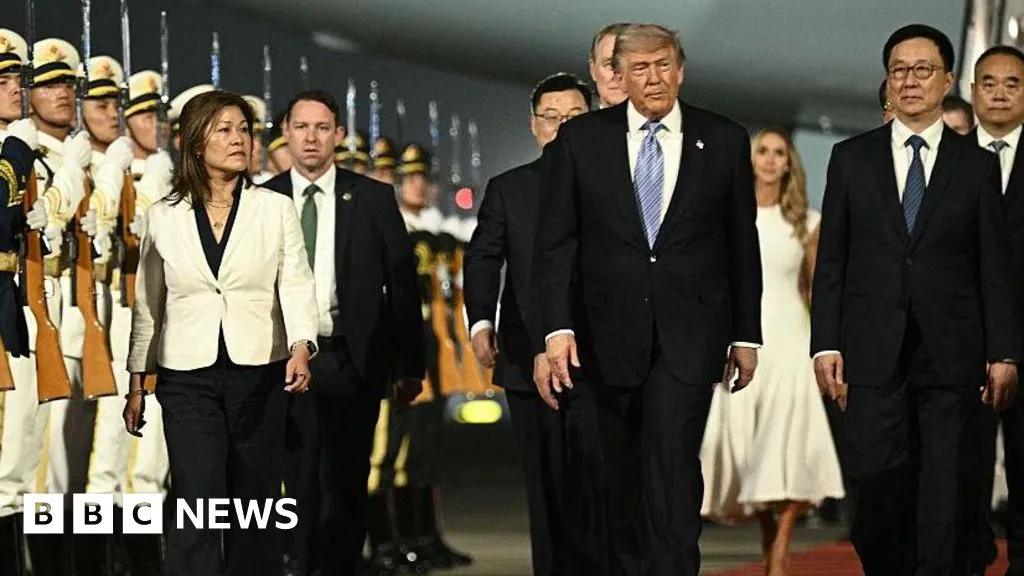
As tensions rise across the globe, US President Donald Trump has landed in Beijing amid a whirlwind of diplomatic negotiations and economic strategy. His arrival on Wednesday was marked by a display of both pageantry and purpose, setting the stage for crucial discussions with Chinese President Xi Jinping.
This two-day summit is expected to tackle pivotal issues, including trade relations, the conflict in Iran, and the contentious status of Taiwan. During his visit, Trump is keenly aware that he returns to a China that is far more assertive than it was during his first state visit in 2017, a factor that is likely to influence every aspect of their negotiations.
In remarks made post-landing, Trump articulated his vision for engagement, stating, "I will be asking President Xi, a Leader of extraordinary distinction, to 'open up' China so that these brilliant people can work their magic, and help bring the People’s Republic to an even higher level." This statement embodies Trump’s first priority, as he aims to facilitate greater collaboration and trade between the two superpowers.
However, the road ahead is fraught with challenges. Bilateral trade has plummeted in recent years following an intensifying tariff war, dropping from a high of $690.4 billion in 2022 to just $414.7 billion last year. Trump is also confronting a significant trade imbalance, with American imports from China outpacing exports by over $200 billion.
On the technological front, the rivalry between the US and China has heated up, particularly regarding artificial intelligence and semiconductor manufacturing. Trump is expected to push for increased purchases of US agricultural products while China may advocate for the lifting of tariffs that have strained commerce.
The negotiations are not limited to economic interests; the ongoing war in Iran is anticipated to dominate discussions as well. China has historically relied on Iranian oil, but the conflict has disrupted exports, exacerbating the risks for both nations. Trump, referring to imminent talks on the subject, asserted, "We will have a long talk about Iran," even as he downplayed a need for Chinese assistance in mediating the dispute. Rising oil prices are causing economic tremors throughout China's markets, making this issue one of mutual concern.
Tensions surrounding Taiwan are also expected to play a significant role in the dialogue. The Trump administration's mixed signals regarding US support for Taiwan invite scrutiny, especially following a bipartisan letter from US senators urging Trump to firmly affirm American backing and recall the recent $14 billion arms sale approved by Congress.
As the summit unfolds, analysis regarding who holds the upper hand in the negotiations will captivate not only political observers but also the global economic community. Trump’s schedule includes a formal welcome ceremony at the Great Hall of the People and a state banquet, marking a historic moment for US-China relations.
The stakes are undoubtedly high as both leaders grapple with the geopolitical nuances that could redefine the future of global diplomacy and economic interdependence.
Source: BBC News
Source: BBC World News