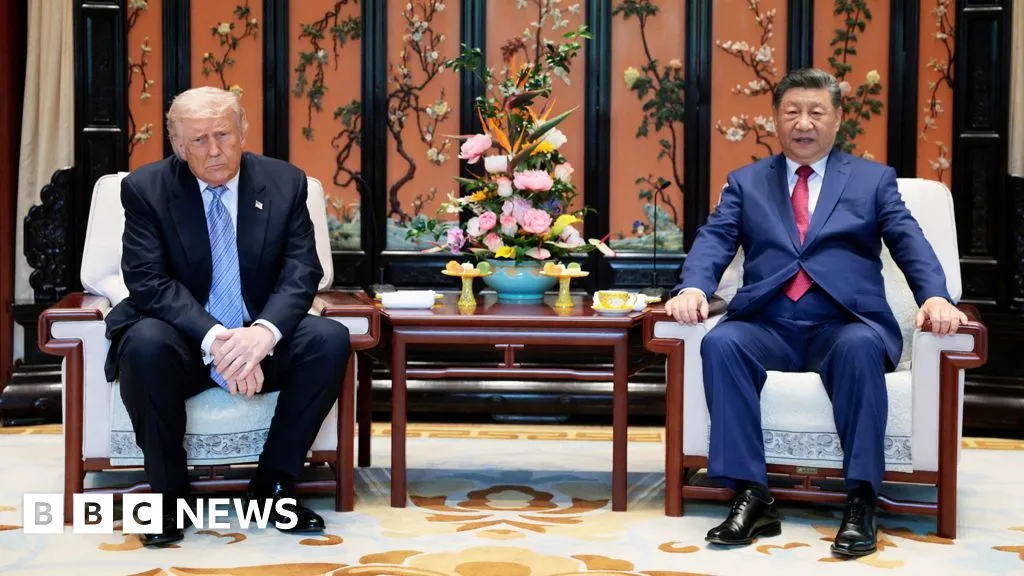
In a high-stakes summit defined by pageantry but short on concrete outcomes, U.S. President Donald Trump and Chinese Premier Xi Jinping concluded two days of discussions, heralding the talks as "very successful". Despite the upbeat rhetoric, no immediate trade agreements were publicly announced, leaving many in business circles awaiting definitive commitments.
The summit, held in Beijing, came at a critical juncture for U.S.-China relations, with expectations running high for breakthroughs amid unresolved trade tensions and an expiring tariff truce. Attended by leaders from major American corporations spanning industries like agriculture and high-tech, the meeting was marked by a flurry of ceremonial engagements, including a state banquet and personal invitations to prestigious venues.
President Trump characterized the outcome positively, asserting that he had secured "fantastic trade deals that are great for both countries." Among the highlights was a claimed agreement for China to purchase 200 Boeing jets, with potential commitments for an additional 750 aircraft. However, officials at Boeing did not immediately confirm any such deal, raising skepticism among analysts.
While Trump expressed optimism about American farmers benefiting from future soybean sales to China, these claims remained unvalidated by Chinese officials. Foreign Ministry spokesperson Guo Jiakun reiterated the need for mutual benefit in U.S.-China economic relations, emphasizing cooperation over competition.
The narrative around the talks was dominated by symbolic gestures rather than definitive agreements. Both leaders discussed the need to implement prior understandings, yet there were no significant announcements regarding tariffs or trade policy adjustments. Interestingly, Trump noted in a press briefing aboard Air Force One that tariffs did not enter the conversation, contravening earlier expectations.
Key Players and Emerging Technologies
One standout moment from the summit was the prominent presence of tech titans, including Tesla CEO Elon Musk and Nvidia's Jensen Huang, hinting at the increasing significance of technological sectors in economic negotiations. Nvidia's inclusion prompted speculation that U.S.-China discussions may be gravitating towards issues surrounding artificial intelligence and semiconductor access—areas critical to both countries’ economic futures.
Tesla's future in China remains a focus area, as the automaker heavily relies on its domestic manufacturing hub and the Chinese consumer market. Meanwhile, Nvidia seeks to reestablish its foothold in China, where current U.S. export controls are hindering sales of advanced chips.
As global leaders continue to grapple with the ramifications of international trade agreements, the Beijing summit stands as a reminder of the complexities inherent in U.S.-China relations. While the talk was encouragingly framed by both sides, the absence of substantial commitments raises lingering questions about the future trajectory of these vital economic ties.
As both nations navigate a landscape fraught with geopolitical tension and trade intricacies, observers remain vigilant, hoping for clarity in the weeks ahead, especially with the tariff deadline looming.
Source: BBC News
Source: BBC World News