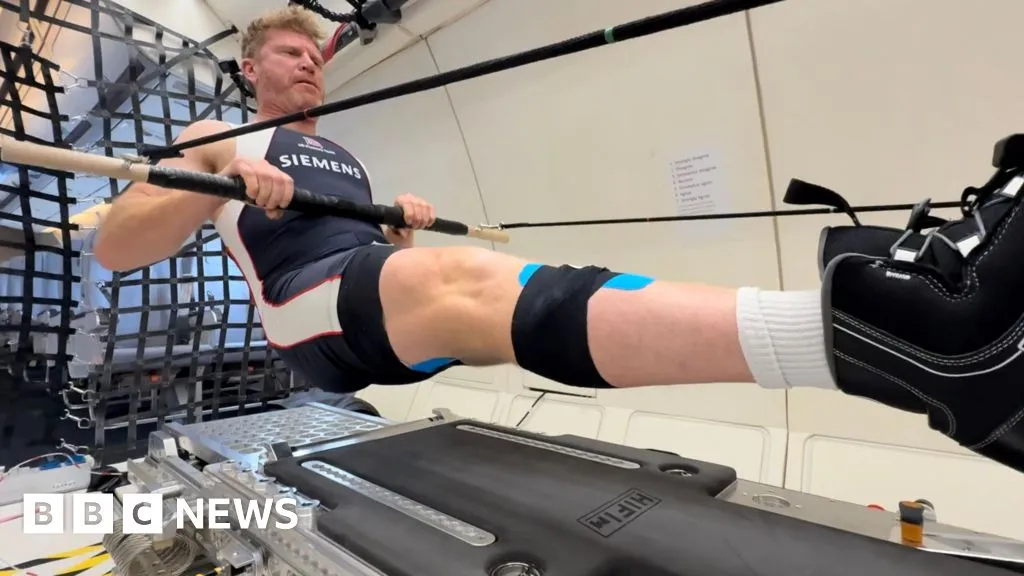
As humanity prepares for prolonged missions to the moon and beyond, a unique competition is unfolding on Earth: the race to develop innovative exercise equipment tailored for astronauts. Olympic rower Matthew Wells is at the forefront of this endeavor, testing groundbreaking fitness technology aboard an aircraft designed to replicate the weightless conditions of space.
Flying at 28,000 feet, Wells rowed fiercely, his body floating for 22 seconds—a surreal experience borne out of a necessity to maintain physical health in zero gravity. "Isn't it every kid's dream to be an astronaut?" he mused, reflecting on his participation in this vital project. The high stakes of space exploration demand astronauts remain physically fit to combat the adverse effects associated with long-duration flights.
Currently, astronauts aboard the International Space Station (ISS) must dedicate at least two hours a day to exercise to prevent muscle atrophy and bone density loss. The equipment Wells is trialing, known as High-Frequency Impulse for Microgravity (HIFIm), is a product of international collaboration spearheaded by agencies such as ESA, NASA, and the UK Space Agency. This innovative apparatus is designed to deliver high-intensity workouts in a fraction of the time, enabling astronauts to maximize their fitness during missions.
Groundbreaking Collaborations in Space Fitness
HIFIm was one of several concepts developed through a competitive initiative aimed at creating exercise solutions for NASA's Gateway lunar orbital platform. Dr. Meganne Christian, a reserve astronaut for ESA and senior exploration manager at the UK Space Agency, highlighted the importance of these devices amid a pivotal era in lunar exploration. "We stand at a truly exciting moment where our inventions can be realized for both new lunar outposts and extended missions, such as the Artemis program aiming to establish a sustained presence on the moon," she explained.
Global Efforts to Keep Astronauts Fit
The British innovation is not alone in this field; other teams worldwide are racing to produce advanced fitness equipment. A notable contender is the European Enhanced Exploration Exercise Device (E4D), developed by the Danish Aerospace Company. This versatile machine accommodates multiple workout forms—including cycling, rowing, and resistance training—while integrating motion capture technology to provide astronauts with performance analytics.
Any insights gleaned from recent missions, such as the Artemis II flight, contribute to the next generation of exercise devices. A specially designed flywheel was employed during this mission, emphasizing the indispensable role of maintaining physical fitness in the harsh conditions of space travel. According to NASA, the rigorous development of exercise apparatus will be critical for ensuring astronaut well-being on expeditions into deep space.
As the landscape of space exploration continues to evolve, the necessity for robust, efficient exercise solutions remains clear. Dr. Dan Cleather, a professor of strength and conditioning involved in the development of HIFIm, stressed that without proper physical conditioning, astronauts face deteriorating coordination and cardiovascular challenges, ultimately jeopardizing mission operations.
Ensuring the health of astronauts in an environment devoid of gravity is not just a matter of innovation but a testament to human ingenuity as we seek to push the boundaries of exploration.
Source: BBC Science