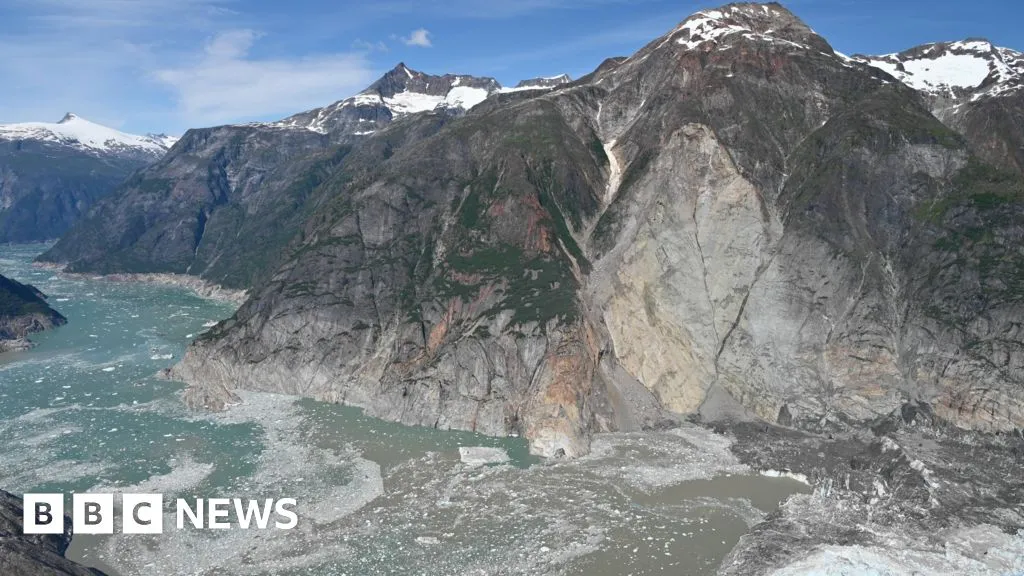
A colossal megatsunami triggered by a catastrophic landslide in Alaska has emerged as the second tallest wave ever documented, underscoring grave risks associated with climate change and glacier retreat.
Last summer, a powerful wave surged through the isolated fjords of Southeast Alaska, wreaking havoc in its path. Although this event went largely unnoticed at the time, a new investigative report reveals it was catalyzed by a staggering collapse of 64 million cubic meters of rock—equivalent to the weight of 24 Great Pyramids—into the sea. This event produced a towering wave that soared almost 500 meters high, narrowly avoiding a disaster for nearby cruise ships due to its early morning timing.
Dr. Bretwood Higman, an Alaskan geologist who examined the aftermath at Tracy Arm Fjord, described the event as “a close call,” expressing concern for future occurrences. “We know there were people who were very nearly in the wrong place,” he stated, warning about the potentially catastrophic implications of such natural phenomena.
Tracy Arm, with its steep cliffs and icy landscapes, is especially vulnerable to these massive waves, known as megatsunamis. Triggered by landslides—typically linked to earthquakes or destabilized rock formations—these waves differ from traditional tsunamis that travel vast ocean distances, often causing widespread devastation.
The largest recorded megatsunami occurred in the 1950s, surpassing 500 meters in height. However, scientists now highlight that the risk of megatsunamis is escalating, largely due to the impacts of climate change. According to recent research published in the journal Science, the accelerated melting of glaciers may significantly increase the likelihood of landslides in regions like Alaska.
Dr. Stephen Hicks, a researcher from University College London, noted that the glaciers had previously stabilized the rock face. With their retreat, the rock became susceptible to collapse, leading to dramatic changes in the fjord's landscape and heightening the risk to those exploring Alaska's natural beauty. “More people are now venturing into these remote areas,” he cautioned, alluding to rising tourist activities. “They are learning about climate change yet are increasingly exposed to associated dangers.”
Dr. Higman concurs that the frequency of megatsunamis is likely worsening. “At this point, I’m pretty confident these events are not just increasing slightly, but exponentially—perhaps by a factor of ten compared to a few decades ago,” he stated, advocating for enhanced monitoring of hazardous zones in Alaska.
In response to soaring safety concerns, several cruise companies have begun to reconsider their itineraries, ceasing operations in Tracy Arm to protect tourists from potential disasters. As climate change continues to reshape the landscape, experts urge vigilance and preparedness in the face of nature’s colossal forces.
Source: BBC Science